
A network that performs under real load, not just on paper.
Most networks aren't badly designed on day one — they drift there, as branches get added, devices multiply, and cabling gets patched in without documentation. We design and build LAN, WAN and wireless infrastructure that's structured to begin with, and we keep it that way as your organisation grows around it.
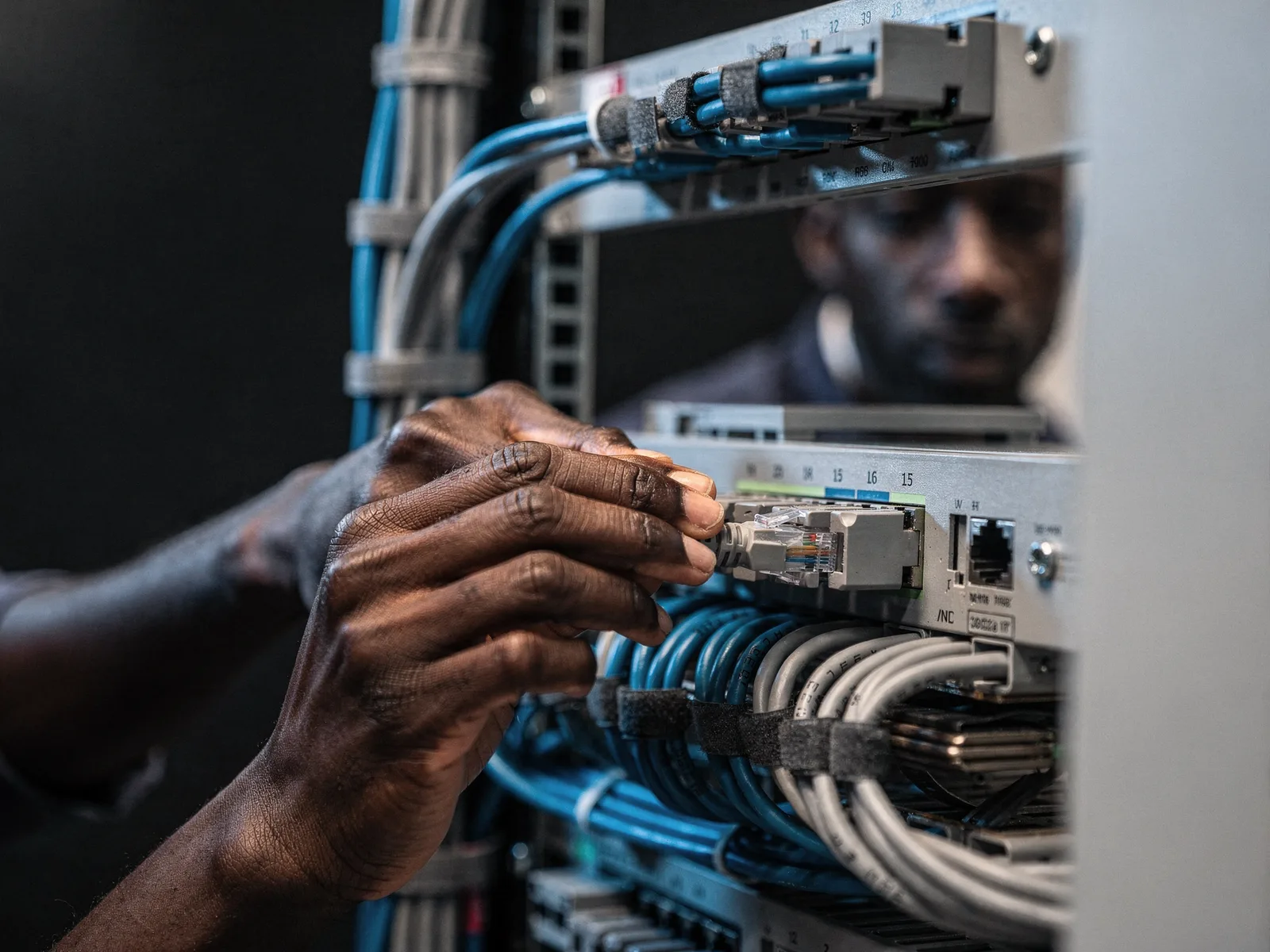
Networking issues rarely show up as one clean fault.
Most engagements start with a symptom the business is already feeling, not a request for a network diagram.
Connectivity that's slow or inconsistent
Applications lag at certain times of day or on certain floors, and nobody can point to why without guessing.
Cabling nobody has documented
Ports were added over years by different people. Tracing a single connection means physically following a cable.
Little to no network segmentation
Guest devices, staff workstations, servers and IoT equipment all sit on the same flat network.
Growth outpacing the network
New staff, new offices or new systems keep landing on infrastructure that was sized for a smaller organisation.
Unreliable branch or site links
A second location, warehouse or retail site connects back to head office over a link that drops or crawls.
Wireless dead zones and congestion
Wi-Fi coverage was never planned against the building layout, so some areas have none and others are overloaded.
Networking capabilities, grouped by where they apply.

LAN Design & Structured Cabling
- Local area network design for offices, floors and buildings
- Structured cabling — copper and fibre, planned and labelled
- Switch selection, configuration and redundancy
- Cable management and as-built documentation
WAN & Multi-Site Connectivity
- Wide area network design linking head office and branches
- Site-to-site connectivity over available carrier links
- Routing design and failover between links where feasible
- Bandwidth planning based on actual application needs
Wireless Networking
- Wireless site surveys and access point placement
- Coverage and capacity design for real device density
- Guest, staff and secure wireless networks kept separate
- Wireless controller setup and ongoing tuning
Segmentation & Network Optimisation
- VLAN design to separate traffic by function and risk
- Quality of service (QoS) for latency-sensitive applications
- Traffic analysis to find and resolve bottlenecks
- Capacity planning ahead of known growth
Documentation & Monitoring
- Network diagrams and cabling records kept current
- Device inventory and configuration backups
- Monitoring for outages, congestion and failing hardware
How a typical engagement runs.
Assess
We walk the site, review existing cabling and configuration, and talk to the people who feel the network's problems day to day.
Design
We design LAN, WAN and wireless architecture sized to current load and known growth, not just what's easiest to install.
Implement
Structured cabling, switching, routing and wireless are installed, configured and documented as they go — not after the fact.
Support
Monitoring and periodic review keep the network performing as devices, staff numbers and applications change.
What this work is actually for.
Connectivity people stop noticing
Staff and systems get on with work instead of routing around a network that keeps interrupting them.
Room to grow without a redesign
A new floor, branch or headcount increase lands on infrastructure built with that growth in mind.
Documentation that's actually current
Diagrams, labelling and configuration records that match what's really installed, so faults get traced quickly.
One accountable team, not several
The same team that built the network also secures it, backs it up and supports it — no gaps between vendors.
The network is the foundation everything else runs on.
Common questions about our networking services.
Can you guarantee a specific speed or uptime figure?
Do you work with our existing cabling and switches, or does everything get replaced?
Can this be done without shutting the office down?
We have branch offices outside Dar es Salaam. Can you support those too?
How does networking work relate to your Managed IT Support service?
Not sure whether the problem is your network?
A short conversation with a solutions expert is often enough to tell you where to start.